





An unfinished concrete basement containing a metal HVAC air handler, exposed wooden ceiling joists with sheet-metal ducts, a hanging bare bulb, copper pipes, and stacked cardboard boxes.

Furnace Repair in West Burke, VT

Tell us about the job

Takes about a minute. No obligation.

RepairFurnace or heatingCaledonia County, VT
Step 1 of 2

What ZIP code is the job in?

Furnaces in Caledonia County run from September through May. That's nine months of the year the burner and blower are cycling on and off, night after night. Overnight lows average 9°F through December, January and February, so on the coldest nights your furnace isn't just running, it's running close to flat out to keep up. That kind of stretch wears on an igniter or a blower motor faster than a mild climate ever would. If something's acting up now, odds are the system has earned it. Worth having someone look at the actual cause before winter asks more of it.

9 months
September through May, your furnace is on duty
9°F
the average winter night it heats against
38 winter storms
in ten years, the nights a failure hurts most
Isometric cutaway illustration of a single-story house showing interior rooms, furniture, a dark furnace unit with a tall vertical flue pipe, and ductwork running under the pitched shingle roof.
Your furnace works hardest from November through March.

NOAA nClimDiv, 1991–2020 normals

Many homes in West Burke still heat with oil, and oil ran $26.53 per million Btu in Vermont last year.

A furnace that's short-cycling or running longer than it should burns through that oil fast, so a bad igniter or thermostat problem costs you more here than it would somewhere cheaper to heat.

West Burke sees its share of storms and outages, but that's not why your furnace is acting up

92 severe weather events from 2015 to 2024
21% of homes statewide lost power a day or more in 2024
44 damaging wind events from 2015 to 2024
Heat starts in September hereFurnace season starts in September here, and runs through May.

Half the homes in Caledonia County were built in 1973 or earlier. If yours is one of them, the furnace itself isn't necessarily that old, but if it's the original unit, it's had decades to wear down. Furnaces don't usually fail all at once. An igniter stops lighting reliably, a blower motor starts drawing more than it should, a heat exchanger develops a crack nobody notices until carbon monoxide becomes the issue. Each of those is its own repair, but they tend to show up closer together once a system gets old. Before you put money into fixing whatever's wrong right now, it's worth finding out how much furnace you've got left underneath it.

Find out what's actually wrong before the furnace has to work any harder

Get the cause checked now, while the furnace still has a stretch of winter left to run. A repair that holds matters more here than somewhere it only has to work a few months a year.

Find a contractor
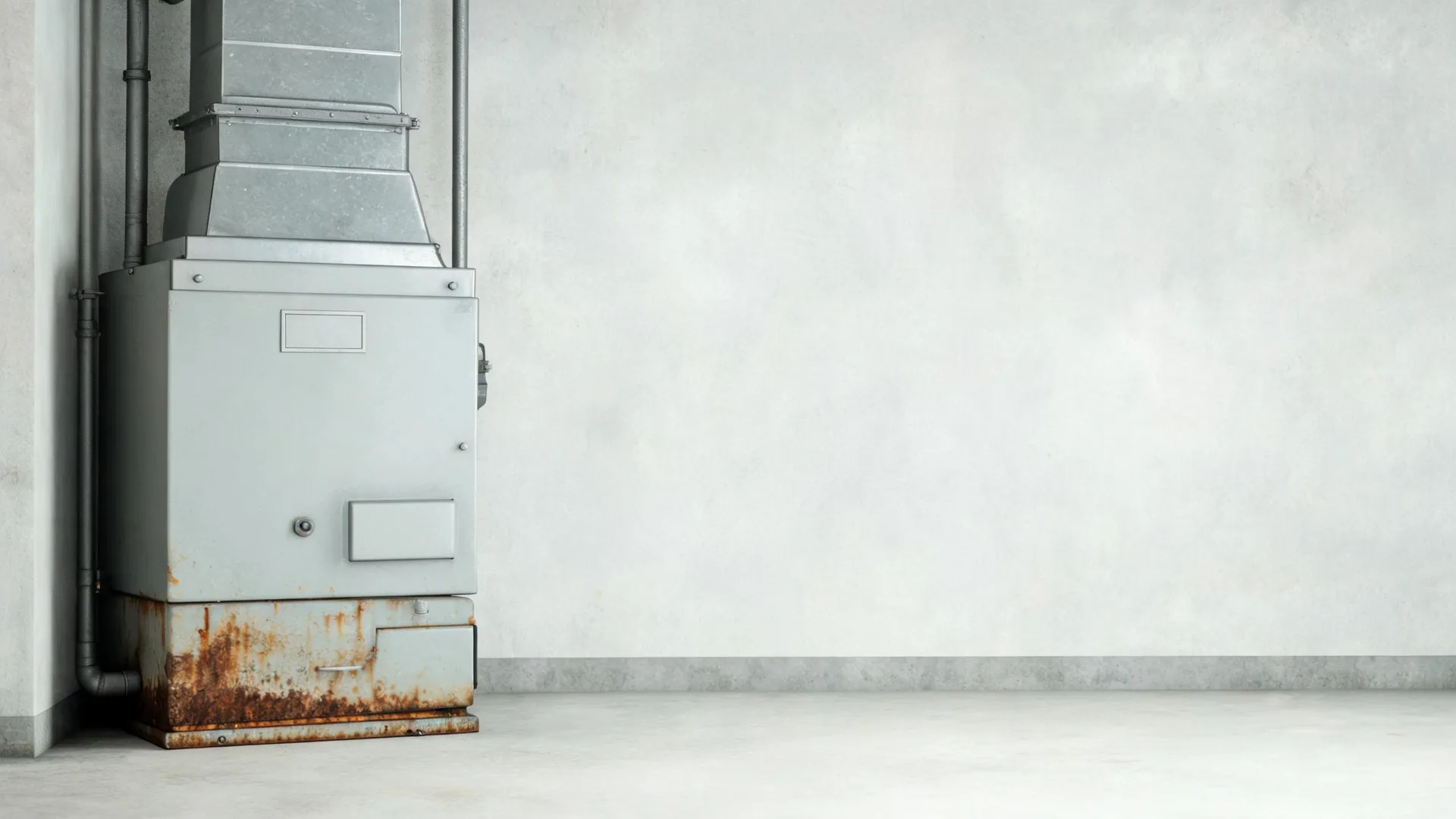
A gray residential gas furnace installed in an unfinished basement, connected to sheet-metal ductwork and PVC pipes.

What your furnace is telling you before it quits

A furnace rarely quits outright. It gives you something to notice first. The burner lights late, or lights and goes out, or you hear the igniter clicking without catching. The blower runs longer than it used to, or kicks on and off more than it should, a sign of short-cycling that puts extra wear on every part it touches. Air coming out of the vents feels cooler than it used to, even with the thermostat set the same as always. Sometimes it's a smell, a burning dust smell the first few times it runs, which is normal, or something sharper and more persistent, which isn't. A rattle or a squeal from the blower compartment usually means a motor bearing or a loose belt wheel, something that gets worse, not better, if it's left alone. None of these mean the furnace is done. They mean it's telling you what's wearing out, while it's still just one part and not several.

A small fault makes other parts work harder

A thermostat still calls for the same warm air whether the burner's lighting clean or struggling. So if the burner's weak, the blower compensates by running longer to push out enough heat, and a motor running longer than it was built for sheds its bearings faster. One worn part starts wearing the part next to it.
Some failures only move one direction

A cracked heat exchanger doesn't heal itself, and a motor bearing that's gone loud doesn't quiet back down. Letting the furnace keep running on a fault like that doesn't buy time, it spends it. The repair that would have fixed one part now has to catch up to whatever gave out alongside it.

Most furnace failures trace back to one of a handful of parts. The igniter is the one that goes most often, since it heats up and cools down every single cycle and that stress eventually cracks it. Flame sensors foul up with a thin layer of oxidation and stop telling the control board a flame is lit, so the system shuts itself down as a safety measure. Blower motors wear at the bearings from years of running, and you'll hear that before anything else, a squeal or a grinding that doesn't go away. Pressure switches and draft inducers fail quieter, usually from dust or a cracked hose, and the furnace just won't start at all. None of these mean the whole system is bad. They're wear parts, and wear parts get replaced on their own schedule, not the furnace's.

A diagnostic visit starts with watching the furnace run through a full cycle. A tech wants to see the igniter glow and catch, the burner stay lit, the blower come on when it should and shut off when it should. Most problems show up somewhere in that sequence. From there it's a multimeter on the igniter and the flame sensor, a check of the pressure switch and the hose that runs to it, maybe the blower wheel pulled to look at the bearings. A cracked heat exchanger gets checked carefully because that one is a safety call, not just a repair call. By the end you should know which part failed, why that part went bad, and whether it's a single fix or the first of a few still coming.