A weathered wooden picket fence runs diagonally across a mown grass lawn, with a row of two-story light-sided houses and large leafy trees behind it.

Furnace Repair in Rutland, VT

Tell us about the job

Takes about a minute. No obligation.

RepairFurnace or heatingRutland County, VT
Step 1 of 2

What ZIP code is the job in?

Nine months of heat a year

A furnace in Rutland County runs from September through May, with overnight lows averaging 12°F in December, January and February. That's most of the year asking the igniter, the blower motor and the heat exchanger to do their job, not just a few cold snaps.

What that means for a repair call

A furnace running nine months a year through single-digit nights doesn't short cycle or lose its flame for no reason. Whatever's wrong, the cause is worth finding, so the fix holds through the next storm instead of the next week.

9 months
September through May, your furnace is on duty
12°F
the average winter night it heats against
66 winter storms
in ten years, the nights a failure hurts most
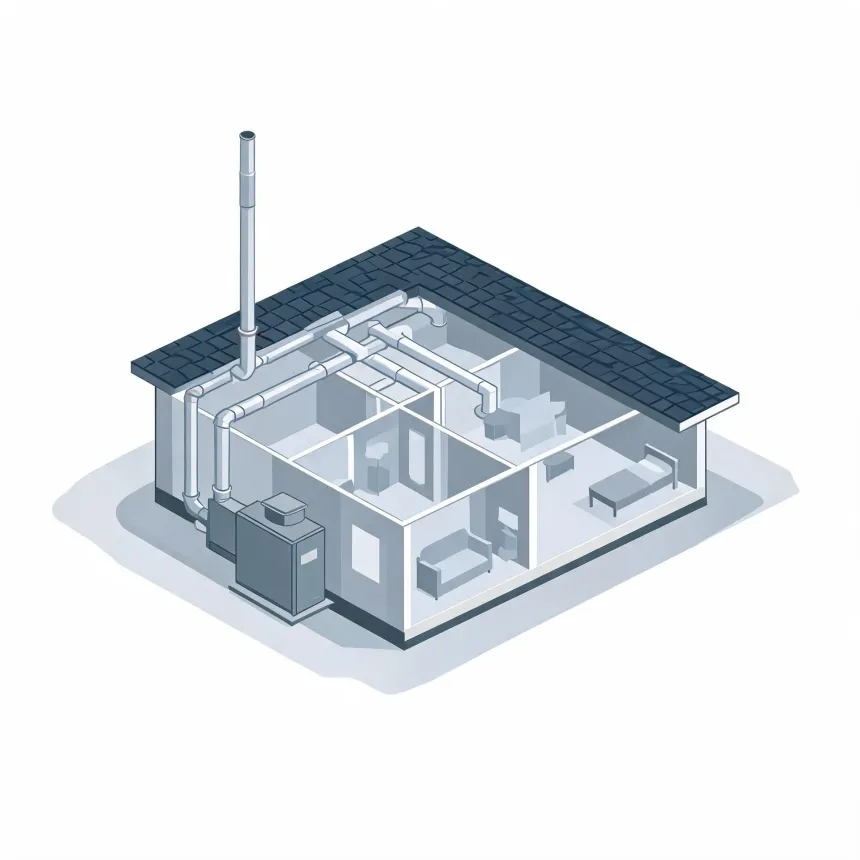
Isometric cutaway illustration of a single-story house with a dark shingled roof, showing interior rooms with furniture, a ducted air distribution system, a tall vertical flue pipe, and a gray furnace unit outside the wall.
Your furnace works hardest from November through March.

NOAA nClimDiv, 1991–2020 normals

Half the homes in Rutland County were built in 1969 or earlier.

A furnace that's been there since the house went up is closer to the end of its life than the start.

If your furnace is original to the house, ask about its remaining life before paying for a major repair

Half the homes here were built by 1969
Heat runs September through May
Winter nights average 12°F

Furnace trouble in Rutland tends to show up in September, right when the heat gets switched back on after sitting idle since spring. A part that was already weak, a cracked igniter, a failing flame sensor, doesn't announce itself over the summer. It waits for that first real call for heat and fails right then. If your furnace struggled to start last September or made it through on the second or third try, it's worth having looked at before this September asks the same thing of it again.

Burning oil to heat a furnace that isn't running right costs you all winter

Vermont homes paid $26.53 per million Btu for fuel oil in 2024. A furnace that's short cycling or struggling to light is burning through that for less heat, not more. The sooner it's looked at, the sooner that stops.

Find a contractor
A man in a navy long-sleeve shirt and tan pants carries a canvas tool bag up concrete steps toward a dark blue front door flanked by columns and a potted shrub.
A gas furnace with attached ductwork, gas piping, and condensate lines installed in a concrete-block basement.

What a diagnostic visit actually checks

A diagnostic call starts with what the furnace is doing wrong. Short cycling. Blowing cold air. Not lighting at all. Tripping its limit switch. The tech checks the easy things first because they're often the real cause, starting with airflow. A dirty filter chokes the system and can make a perfectly good furnace act like it's failing. A flame sensor coated with residue can't prove there's a flame, so the furnace shuts itself down even though it lit fine. After that it's testing, not guessing. Voltage readings at the igniter. Watching the flame through a full cycle. Checking that the pressure switch responds when the inducer motor spins up. A limit switch that keeps tripping means something's overheating, and the tech has to find out if that's a weak blower, a blocked duct, or a cracked heat exchanger, because those get treated differently and only one of them means the furnace is done. The point of the visit is finding the part that's actually failing, not the one that's easiest to blame.

A small problem doesn't stay small

A furnace that's short cycling is shutting off before it finishes a heat call, then starting again. Each restart puts a hard load on the igniter and strains the blower motor. What starts as an occasional shutoff turns into a part that fails for good, usually on the night you need it least.

The heat exchanger is the one that can't wait

A limit switch tripping again and again usually means something's overheating. Keep running it and a hairline crack in the heat exchanger can spread. A cracked exchanger lets combustion gas mix with the air moving through the house, so this is the one problem where waiting isn't worth it.

Before anyone comes out, check the filter. Pull it and hold it up to a light. If you can't see light through it, that's enough to cause short cycling or weak airflow on its own. Next check the thermostat. Make sure it's set to heat, not just fan, and that the temperature set point is actually above room temperature. Check that the switch on the furnace itself, the one that looks like a light switch on the side of the unit, hasn't been bumped off. If it's a gas furnace, make sure the gas valve is open. Beyond that, don't take the burner compartment apart and don't reset the furnace more than once. A furnace that won't relight after one reset has a reason, and finding it takes a meter and a manometer, not a flashlight.

A furnace is worth repairing when the problem is one part doing its job badly. An igniter, a flame sensor, a pressure switch, a blower motor. Swap the bad part and the rest of the furnace, the heat exchanger, the cabinet, the gas valve, goes back to doing what it's always done. Replacement makes sense when the part that's failing is the furnace itself, not something bolted to it. A cracked heat exchanger means the furnace is done regardless of how everything else tests out. So does a control board that's failed once and will fail again because the parts around it have worn to the point of stressing it. The other thing worth weighing is how many separate repairs a furnace has needed. One failed capacitor is a repair. A furnace that's had its igniter, its flame sensor and its blower motor each go in the last few years is telling you it's wearing out all over, not in one spot, and the next failure is already waiting somewhere else in it.