A tabby cat sleeps on a large bed in a dark, modern bedroom equipped with a wall-mounted air-conditioning unit.

Mini Split Installation in Woodstock, VT

Tell us about the job

Takes about a minute. No obligation.

New system or replacementMini-splitWindsor County, VT
Step 1 of 2

What ZIP code is the job in?

Oil heats most homes here

Fuel oil or kerosene heats close to 46 percent of homes in Windsor County, more than any other fuel. Propane comes next at nearly 25 percent. Gas and electric heat are both uncommon here. A mini split doesn't touch any of that wiring or piping. It runs on its own electrical circuit.

What that means for a mini split job

Most homes in the county already have an oil or propane furnace or boiler doing the heavy lifting. A mini split usually gets added alongside that system rather than replacing it, often to cover a room that runs hot or cold or to add air conditioning where there isn't any. The install work is about where to run the line set and mount the outdoor unit, not about connecting to a fuel line or ductwork.

9 months
September through May, your system heats
1 months
July through July, it cools
12°F
the average winter night it heats against
77°F
the average summer afternoon it cools against
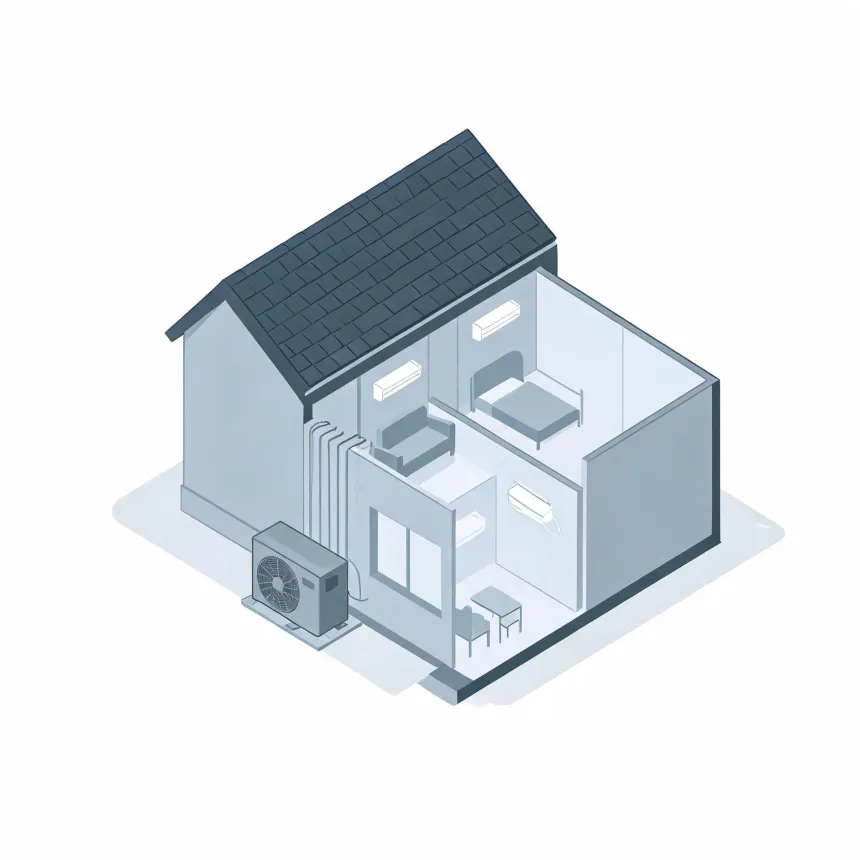
Isometric illustration of a cutaway house with a dark shingled gable roof, showing interior rooms with a bed, chairs and table, three wall-mounted mini-split indoor units connected by line sets to an outdoor condenser unit on a pad outside.
Your system heats September through May and cools July through July.

NOAA nClimDiv, 1991–2020 normals

Half the houses in Windsor County went up in 1973 or earlier.

An old house rarely matches new ductwork or framing, so the mini split has to work with the walls and rooms already there.

July is the only cooling month here, so get it mounted before it

Cooling runs July through July
Summer afternoons average 77°F
70 damaging wind events from 2015 to 2024

A standard single or multi-zone system is sized for a room or two, not a whole house, and that's exactly what most mini split jobs here call for. There's no reason to size up. Electricity runs 21.90 cents per kilowatt-hour in Vermont homes, on the higher side, but a mini split is efficient enough that this isn't a reason to shop for a smaller unit or a cheaper one. Get the size right for the space it's covering and the efficiency rating that fits your budget. Nothing about Woodstock pushes you toward a bigger compressor or a higher-tier model than you'd use anywhere else.

One month of real work a year

July is the only month that calls for cooling here, and even then afternoons average 77 degrees. A mini split in Windsor County isn't running hard for months on end. That makes a reliable mid-range system a sound choice. Put the money into getting the size and the install right, not into a higher tier of compressor you won't need.

Find a contractor
A white mini-split air conditioner outdoor condenser unit mounted on metal brackets against a beige stucco exterior wall, with a blue sky and scattered clouds in the background.

Working with the house you have

A line set can usually be run along baseboards or through a closet chase without opening up a wall. That's the detail to settle on a walkthrough before the install date is set, not after the crew shows up. Where the walls allow a short, direct run, the job goes faster and there's less patching after.

The outdoor unit and the line set drive the labor

Where the outdoor unit can sit, and how far the line set has to travel to reach it, decides most of the install time. A short, straight run along an exterior wall goes quickly. A run that has to clear a corner, climb a floor, or pass through finished space takes longer and calls for more care closing it up.

Zones and head count are a separate decision from size

A single-zone system cools or heats one room from one outdoor unit. A multi-zone system splits that same outdoor unit's capacity across several indoor heads, each on its own line set and its own mount. More heads means more line sets to run and more spots to patch, apart from whatever capacity the space actually needs.

If this is going in alongside an oil or propane system rather than replacing it, there's nothing to remove. The furnace or boiler stays right where it is, doing what it already does. Where a mini split does replace something is an old window unit or electric baseboard heat in one room. A window unit just comes out of the frame, and whatever was patching that gap can be cleaned up and sealed properly once the line set is in. Electric baseboard is a bit more work, since it means capping off that circuit or repurposing it for the new outdoor unit, and that's a job for whoever's running the electrical. Either way, nothing about adding a mini split requires tearing out ductwork, because there usually isn't any to tear out.

The crew runs the line set between the indoor and outdoor units, a refrigerant line and a drain line bundled together, then cuts a hole where that line set passes through the wall. That penetration gets sealed from both sides once the lines are through, not left for later. Indoors, the mounting plate goes up first so the head hangs level, then the lines connect and get wrapped where they're exposed. Outdoors, the compressor sits on a pad or wall bracket, set where nothing blocks the airflow around it. Once everything's connected, the line gets pressure tested and pulled down to a vacuum before any refrigerant moves. That vacuum test is what confirms there's no leak at a fitting before the system ever runs.