A standard mini split handles this job
Vergennes homes don't need an oversized system or a special cold-climate model beyond what's standard for Vermont. A properly sized unit, matched to the space, covers both the heating and cooling load here.
Takes about a minute. No obligation.
Vergennes homes don't need an oversized system or a special cold-climate model beyond what's standard for Vermont. A properly sized unit, matched to the space, covers both the heating and cooling load here.
Vermont homes paid 21.90 cents per kilowatt-hour in 2024, higher than the national average. Ask what SEER2 and HSPF2 ratings the installer is quoting, since a more efficient unit costs less to run at that rate.
NOAA nClimDiv, 1991–2020 normals
The old system doesn't just unplug and disappear once the new one goes in.
Whoever installs the mini split should also be pulling out the old equipment and handling the refrigerant in it properly, not leaving that part to you.



Addison County sits in zone 6A, a cold climate with winter running long here. Any mini split installed has to meet the federal minimums for a split-system heat pump, since that's what a ductless unit counts as under the standard. That means at least 14.3 SEER2 for cooling and 7.5 HSPF2 for heating, the same floor as any other split system sold today. There's no separate, looser rule for ductless equipment. A unit that meets that bar is also worth checking against the federal efficiency tax credit before you settle on a model.
Half the homes in Addison County were built in 1977 or earlier, half later. Age alone doesn't change what a mini split needs to do here. A unit sized to the room and rated to the standard handles this house the same as a newer one next door.
Find a contractor
Cooling in Addison County only runs in July. June is the month before that starts, and it's the month to get a mini split in and running, not mid-July when the heat has already arrived and every installer in the county has a backlog. Getting it done early means it's tested and ready before that load shows up, on your schedule instead of theirs.
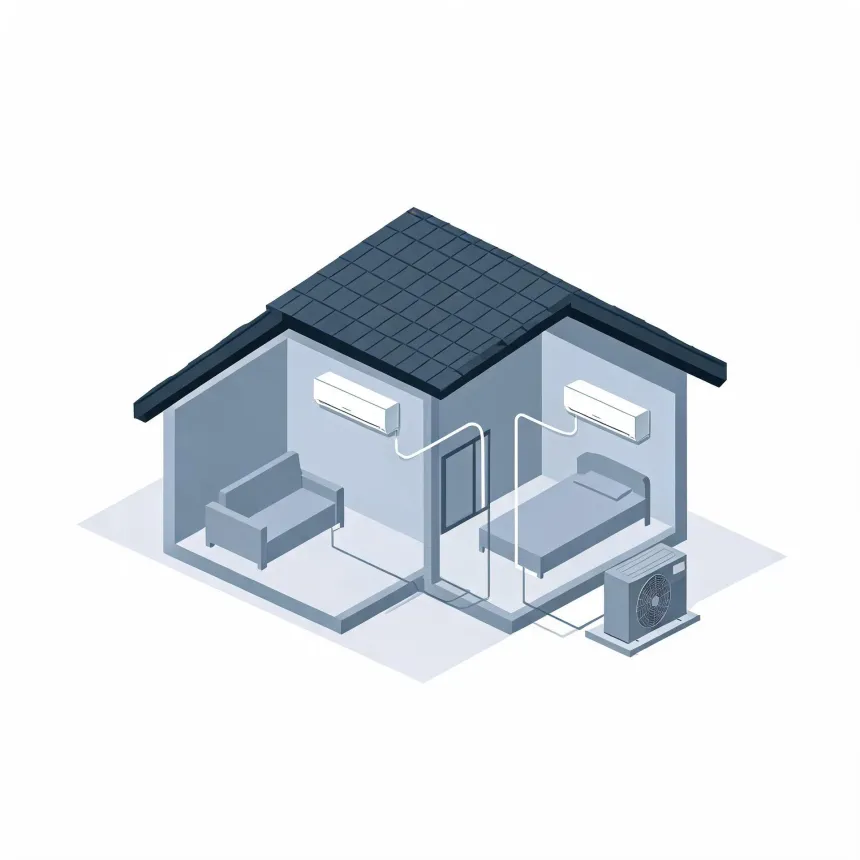
A single indoor head paired with one outdoor unit is the simplest job there is. Add more zones and the outdoor unit has to be sized for all of them running at once. The install itself takes longer too. More line sets, more wall penetrations, more spots to mount a head and run condensate away from it. More zones is more work, not the same job repeated.
The line set connecting the outdoor unit to each indoor head has to go somewhere, and the easy path is rarely the short one. Running it through a finished wall means opening it up and patching after. Running it along an exterior wall or through a chase is faster and leaves less to repair. The distance between indoor and outdoor units, and what stands in the way, drives labor more than the equipment itself does.
Ask every installer for a written heat loss and heat gain calculation on the rooms getting a head, not a flat rule of thumb based on square footage alone. Contractors can walk the same room and size it differently depending on whether they account for windows, insulation and how the room connects to the rest of the house. Ask what happens to the old equipment and who is responsible for the refrigerant in it. Ask whether the outdoor unit holds its rated output when every zone is calling for heat or cooling at once, since some lose capacity under that load. Ask where the line set will run and whether that means opening a finished wall. And ask for the SEER2 and HSPF2 ratings in writing, not just a brand name, so you can compare what you are actually being quoted.
Installation day starts outside. The outdoor unit gets mounted on a bracket or pad, leveled, and given clearance to pull in air on all sides. Indoors, the installer mounts the head, drills through the wall for the line set, and connects the refrigerant lines, the condensate drain and the electrical whip. Once everything is connected, the line has to be pulled down to a vacuum before refrigerant ever flows, which clears out moisture and air that would otherwise ruin the system. After that the unit gets charged, powered up, and run through both heating and cooling to check that every zone hits the temperature it's set to. A good installer tests airflow and drainage at each head before calling the job done, not just the one closest to the outdoor unit.