An orange cat sleeps on a neatly made bed with dark grey bedding in a minimalist bedroom with wall sconces and a mounted air conditioner.

Mini Split Installation in Newbury, VT

Tell us about the job

Takes about a minute. No obligation.

New system or replacementMini-splitOrange County, VT
Step 1 of 2

What ZIP code is the job in?

Oil heats most homes in Orange County

Fuel oil or kerosene heats 39.2% of occupied homes in Orange County, more than any other fuel. LP or bottled gas comes next at 25.9%. Utility gas barely reaches this county at 1.2%, so a gas furnace usually isn't an option here the way it is in other places.
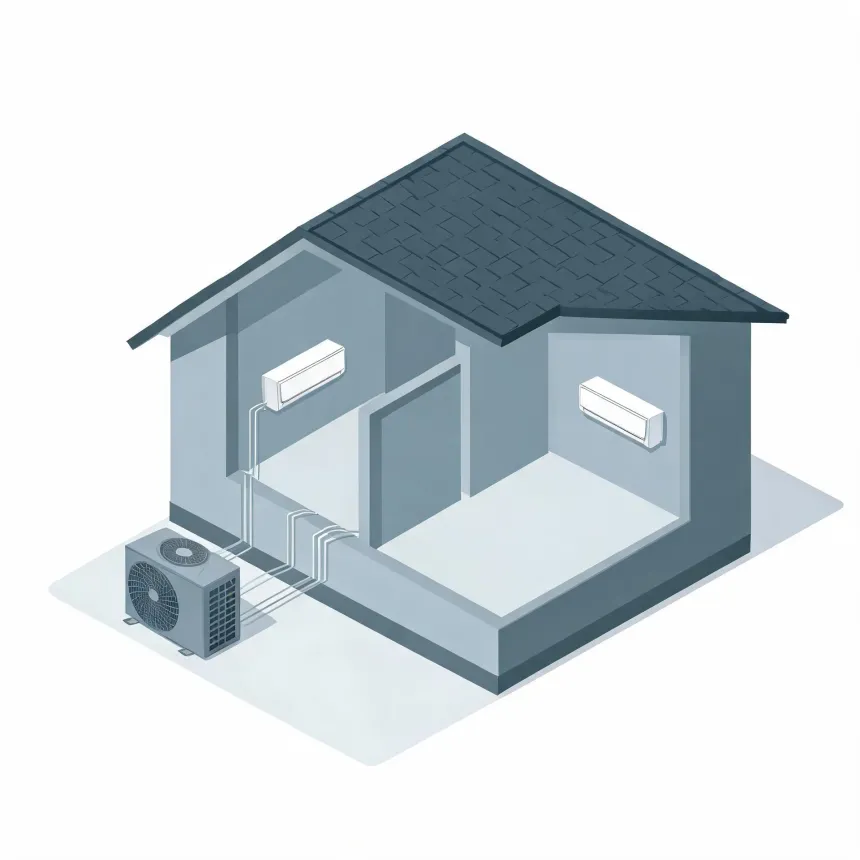

A mini split works alongside what you have

A mini split runs on electricity and doesn't care what heats the rest of the house. It can take over the rooms you use most and let an oil or propane furnace handle the rest, or the coldest days, instead of replacing it outright.

9 months
September through May, your system heats
11°F
the average winter night it heats against
77°F
the average summer afternoon it cools against
Isometric cutaway illustration of a small house showing two wall-mounted indoor air conditioning units connected by refrigerant lines to an outdoor condenser unit on the ground outside.

Vermont homes paid 21.90 cents per kilowatt-hour in 2024.

A standard mini split sized right for the rooms it serves keeps that cost in check, no need to size up.

A 50-50 split on home age, and nothing here that calls for sizing up

Half the homes here were built by 1978
Summer afternoons average 77°F
51 damaging wind events from 2015 to 2024
A mini split that barely has to workSummer afternoons average 77°F, and most months don't get warm enough to need cooling at all.

Newbury sits in climate zone 6A, a cold zone with winter that runs long. Orange County is on the humid side too. Any mini split installed here still has to meet the same federal minimum as anywhere else. That's 14.3 SEER2 for cooling and 7.5 HSPF2 for heating, measured on the unit itself. There's no separate, looser standard just because a system is ductless. Whatever goes in has to clear that bar first.

A standard mini split is still the right call here

Orange County gets its share of rough weather, including windstorms and winter storms most years. None of that changes what the mini split itself needs to be. A standard size and efficiency rating does the job here, same as it would in a calmer county. Worth asking the contractor about backup power if a storm knocks it out, but that's a separate question from sizing the system.

Find a contractor
A white outdoor air conditioner condenser unit mounted on metal wall brackets against gray horizontal siding, with a blue sky and white clouds behind it.

What actually sets the price has little to do with the brand on the unit

A compressor priced for installation is sized to a number, not guessed. Go up a size thinking it buys headroom for the coldest day and the unit now has more capacity than the room can use most of the year. It satisfies the thermostat fast and shuts off, then starts again soon after, and every one of those starts puts more wear on the compressor than the running does. The quieter cost shows up in the install itself. Line set length, where the outdoor unit can sit, how many indoor heads one outdoor unit has to feed, whether a wall needs more than one small hole drilled through it. A straightforward spot with a short line run and one indoor head is a different job from a multi-zone setup feeding several rooms off one outdoor unit, and the work changes with it, not just the equipment.

Ask what the low-temperature rating actually covers

Every mini split has a compressor that keeps producing heat down to some outdoor temperature, and below that point output drops off. Cold-climate models hold their rated output much further down than standard ones. Ask for that number specifically, not just the efficiency rating, since a unit can be efficient in mild weather and still struggle on the coldest night of the year.

Ask how they're sizing each room, not just the house

A mini split that's too big for a room cycles on and off instead of running steady, and that short cycling is what wears out a compressor early and leaves the room feeling clammy. A contractor should be asking about window size, ceiling height and how the room is used before naming a unit, not matching a number off the old system.

Sizing a mini split starts with a heat loss and heat gain calculation for the room, not a rule of thumb based on square footage. A contractor measures the walls, the windows, the ceiling height, and works out how fast that room loses heat in the cold and picks up heat in warm weather. Skip that step and guess instead, and the unit ends up wrong. Undersized, it runs flat out on the coldest or hottest days and never quite catches up. Oversized, it satisfies the thermostat fast, shuts off, then kicks back on shortly after. That short cycling is hard on the compressor and leaves the room swinging between too warm and too cool instead of holding steady. The right size runs longer, steadier stretches, which is both more comfortable and easier on the equipment.

Install day starts with the outdoor unit and where it sits. That spot needs clearance for airflow and a straight-enough path to run the line set through the wall to the indoor head. The crew drills one small hole for the refrigerant lines, the power wire and the condensate drain, then mounts the indoor unit on the wall or ceiling and runs everything back to the compressor outside. Once the lines are connected, the system gets evacuated with a vacuum pump to pull out air and moisture before any refrigerant moves through it. Skip that step and the system can run with moisture trapped in the lines, which causes problems down the road. After that, the refrigerant charge gets checked against what the line length calls for, the unit gets powered up, and the contractor tests heating and cooling before calling the room done.