A two-story red brick house with black shutters and a dark roof sits on a mown lawn behind a dry-stacked stone retaining wall, framed by large deciduous trees under an overcast sky.

Mini Split Installation in Bellows Falls, VT

Tell us about the job

Takes about a minute. No obligation.

New system or replacementMini-splitWindham County, VT
Step 1 of 2

What ZIP code is the job in?

Weather here is hard on outdoor units

Windham County logged 220 severe weather events between 2015 and 2024, most of them damaging wind. A mini split's outdoor unit sits outside year round, so wind-driven debris and snow load are part of what it has to handle. Where you mount it and how it's shielded matters here more than in calmer places.

Plan for the power to go out

Twenty-one percent of Vermont households went at least a day without power in 2024. A mini split needs electricity to run, in both its heating and cooling modes, so it's worth deciding now how you'll keep the house warm if that happens to you.

9 months
September through May, your system heats
1 months
July through July, it cools
14°F
the average winter night it heats against
77°F
the average summer afternoon it cools against
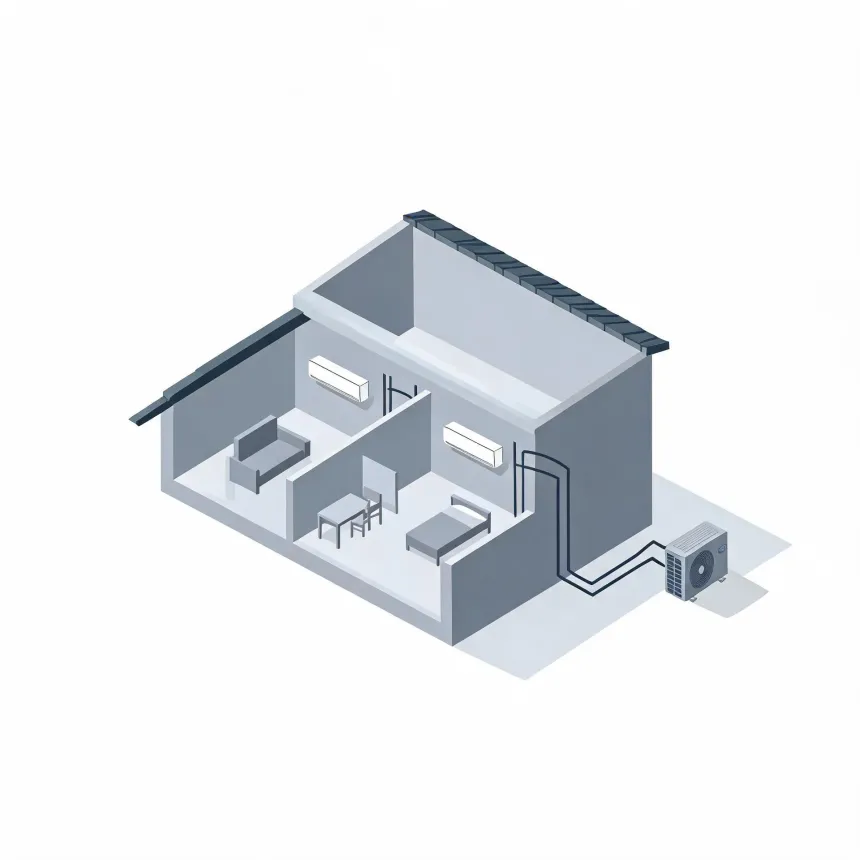
Isometric cutaway illustration of a gray house showing two wall-mounted indoor air conditioning units in separate rooms with furniture, connected by line sets to an outdoor condenser unit on a pad outside.
Your system heats September through May and cools July through July.

NOAA nClimDiv, 1991–2020 normals

Cooling in Bellows Falls runs one month a year, July.

Have the install finished by June, so it's not a rush job in the one month you need it.

Most homes here run on oil, worth knowing before you pick a mini split

51.5% of homes heat with fuel oil
Cooling runs July through July
Summer afternoons average 77°F

July is the only month that asks this system to cool anything, and even then the afternoon high averages just 77 degrees. The rest of the year the load is heating, and Windham County's winters are long enough to carry their own rating, zone 6A, cold with a long season. So the outdoor unit spends most of its life producing heat, not fighting summer afternoons. That's a lighter job than this kind of equipment faces in hotter places. A dependable cold-climate heat pump suited to that load matters more here than chasing the highest efficiency number on the spec sheet.

Any new system here has to meet zone 6A minimums

Vermont sits in climate zone 6A, so a mini split installed here has to be a split-system heat pump rated at least 14.3 SEER2 for cooling and 7.5 HSPF2 for heating. That's the floor, not a suggestion, and it narrows the field before you start comparing units. A federal tax credit is available on qualifying systems, which is worth factoring into what you choose.

Find a contractor
A man in a dark shirt and khaki pants, seen from behind, carries a worn leather bag as he climbs wooden porch steps toward a dark front door, with a potted shrub beside the entry.
A white mini-split air conditioner outdoor condenser unit mounted on metal brackets against a beige stucco exterior wall, with a blue sky and scattered clouds in the background.

Sized to the load, not the square footage

A load calculation is done room by room. A tech measures the square footage, counts the windows and checks which way they face, looks at the insulation, and works out how much heat that space loses on the coldest day and gains on the hottest. That number decides which indoor head and outdoor unit go in, not the size of the room by eye. Oversizing is the mistake that comes up more often than undersizing. A unit that's too big cools or heats the room fast, shuts off, then kicks back on a few minutes later. That pattern is called short cycling. A system that short cycles never runs long enough to pull moisture out of the air, so the room can feel cool but damp. The start and stop also wears on the compressor harder than running steady would. A unit sized correctly runs longer, steadier cycles and holds the temperature evenly. Ductless systems carry one more sizing question beyond a central system, which is how many indoor heads a single outdoor unit can carry and whether the layout calls for one zone or several. That gets worked out alongside the load calculation, not after it.

An old baseboard or furnace doesn't have to go anywhere

A mini split can be added alongside an existing oil furnace or electric baseboard without tearing that system out. Plenty of homeowners keep the old heat source as backup for the coldest stretches and let the mini split carry the rest of the year. If the old system is on its way out for other reasons, that's a separate decision from the mini split install.

Old ductwork doesn't need to be touched

A house that heated with forced air has ducts running through it whether or not they stay in use. A mini split delivers air straight from each indoor head, so those ducts can be sealed off and left alone, or opened up and removed if the space behind the walls matters to you. Either way, the mini split doesn't depend on them.

SEER2 and HSPF2 on the label are lab ratings, one for cooling and one for heating, and they tell you how much heat the unit moves for the electricity it uses. A higher rating means more heat moved per unit of power, which shows up as a lower electric bill over a season of running. That number comes from a controlled test, not from your coldest night or the walls of your house, so systems with the same rating on paper can still perform differently once installed. Going above the minimum often buys a better compressor and a quieter unit, since equipment built to hit those higher numbers tends to use sturdier parts throughout. Still, the rating is only part of the picture. A system sized correctly for the space it's heating and cooling, and installed well, will outperform a higher-rated one that's oversized or poorly fitted.

Installation starts with deciding where the outdoor unit and indoor head go, since the line set between them runs through a hole drilled in the exterior wall and that path is fixed once it's drilled. The line set carries the refrigerant lines, a drain line, and electrical wiring together, and the hole gets sealed against weather on both sides when the work is done. Once the lines are connected, the system gets evacuated with a vacuum pump to pull moisture and air out of them before refrigerant is released, because either one left behind can damage the compressor over time. Only after that vacuum holds does the installer charge the system and run it in both heating and cooling to check it before calling the job finished.