Oil heats most homes here
Fuel oil or kerosene heats 44.2% of homes in Washington County, more than any other fuel. Propane comes next at 27.1%. Electric heat and gas furnaces are both uncommon here.
Takes about a minute. No obligation.
Fuel oil or kerosene heats 44.2% of homes in Washington County, more than any other fuel. Propane comes next at 27.1%. Electric heat and gas furnaces are both uncommon here.
Most oil and propane systems here heat the whole house through a furnace or boiler. A mini split doesn't replace that. It covers the rooms where you want cooling or extra heat without touching the oil or propane system already running the rest of the house.
Afternoon highs in Barre only average 75 degrees in June, July and August.
A mini split here isn't working against months of heat, so a mid-range unit holds up fine.




A standard size mini split is the right call here. Nothing about Barre pushes you toward a bigger unit or a higher-end one. Electricity runs 21.90 cents per kilowatt-hour in Vermont, on the higher side, so it's worth picking a unit with a good efficiency rating since you'll feel that rate every time it runs. But that's a reason to check the efficiency number on the label, not a reason to size up. A contractor sizing this for your rooms and your walls will get you the right unit without guessing.
Washington County falls under zone 6A, so any mini split installed here has to meet the federal minimum of 14.3 SEER2 and 7.5 HSPF2, same as any other split-system heat pump. That standard applies whether it's covering one room or several. A federal tax credit is available on qualifying equipment. A contractor can confirm which units qualify and get the paperwork right.
Find a contractor
The old system doesn't get removed as part of a mini split install unless you pay for that separately. If it's a furnace or boiler running on oil or propane, it keeps heating the house the same way it always has. The mini split is new equipment added alongside it, not a replacement, so there's nothing to decommission. If what's coming out is an old window unit or a through-wall air conditioner, that's a smaller job. It unmounts, the opening gets sealed or patched, and the wiring for it either gets capped or reused if the new system can run off the same circuit. A contractor can tell you which during the quote, since it changes what the installation day looks like.
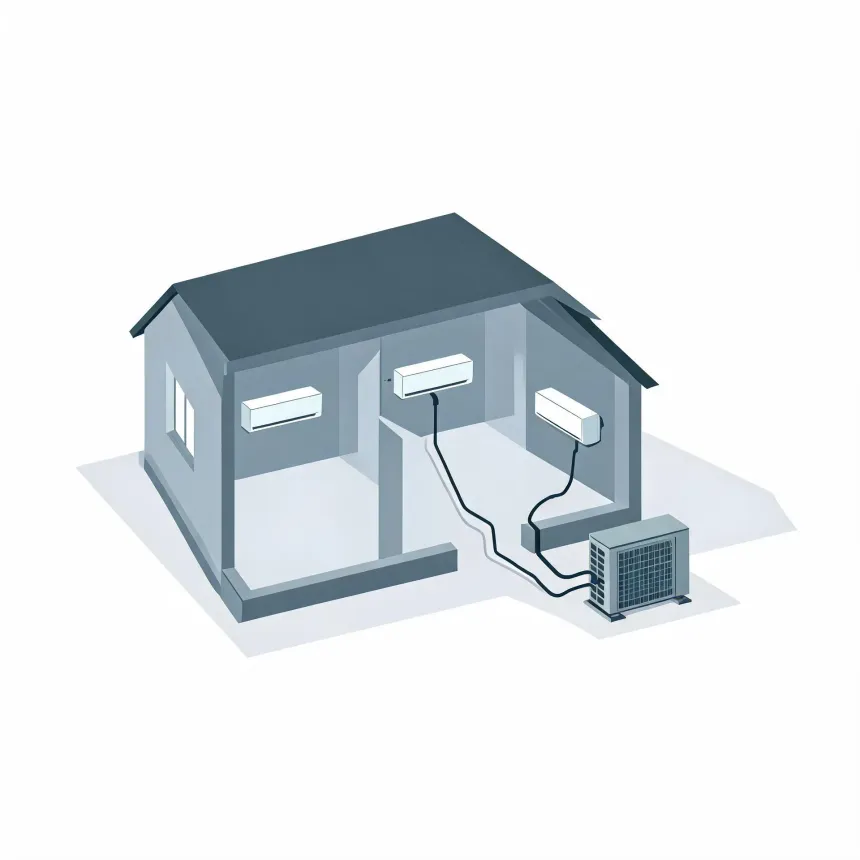
The line set connecting them has to be run through a wall, and the path it takes matters. A short, straight run costs less than one that has to snake around framing or climb between floors to reach where the indoor head needs to go.
Each indoor head needs its own line set run and its own spot on the outdoor unit's capacity. A system with multiple zones also needs a contractor to balance the whole thing so one room doesn't starve while another runs cold, and that balancing is part of what you're paying for.
Sizing a mini split comes down to how much heat the room loses, not how big the room looks. A contractor works out the heat loss for each space. That means the walls, the windows, which way they face, what's on the other side of them. Then that number gets matched to a unit that can cover it. Go too big and the unit short cycles. It kicks on, satisfies the thermostat fast, then shuts off again before it's dehumidified the room or settled into a steady run. Go too small and it runs flat out in the coldest stretches and never quite catches up. Either way you feel it. A room that's clammy in summer, or one that's never warm enough on the worst night of the year. The right size is the one sized to that room, not rounded up for safety.
Installation day starts with the line set, not the equipment. The outdoor unit gets set on a pad or mounted bracket outside, with clearance to pull air through it. Inside, each head gets mounted high on a wall, on a bracket that has to sit level for the condensate to drain right. Running the line set and the drain line through the wall is the part that takes the time, since that path has to connect indoor to outdoor without fighting the framing. Before any refrigerant moves through the lines, a contractor pulls a vacuum on them to clear out air and moisture. Skip that step and moisture gets trapped inside, and it corrodes the lines from the inside over time. Once the vacuum holds, the system gets charged and run through each mode so you can hear what it sounds like and feel what it does before anyone leaves.